
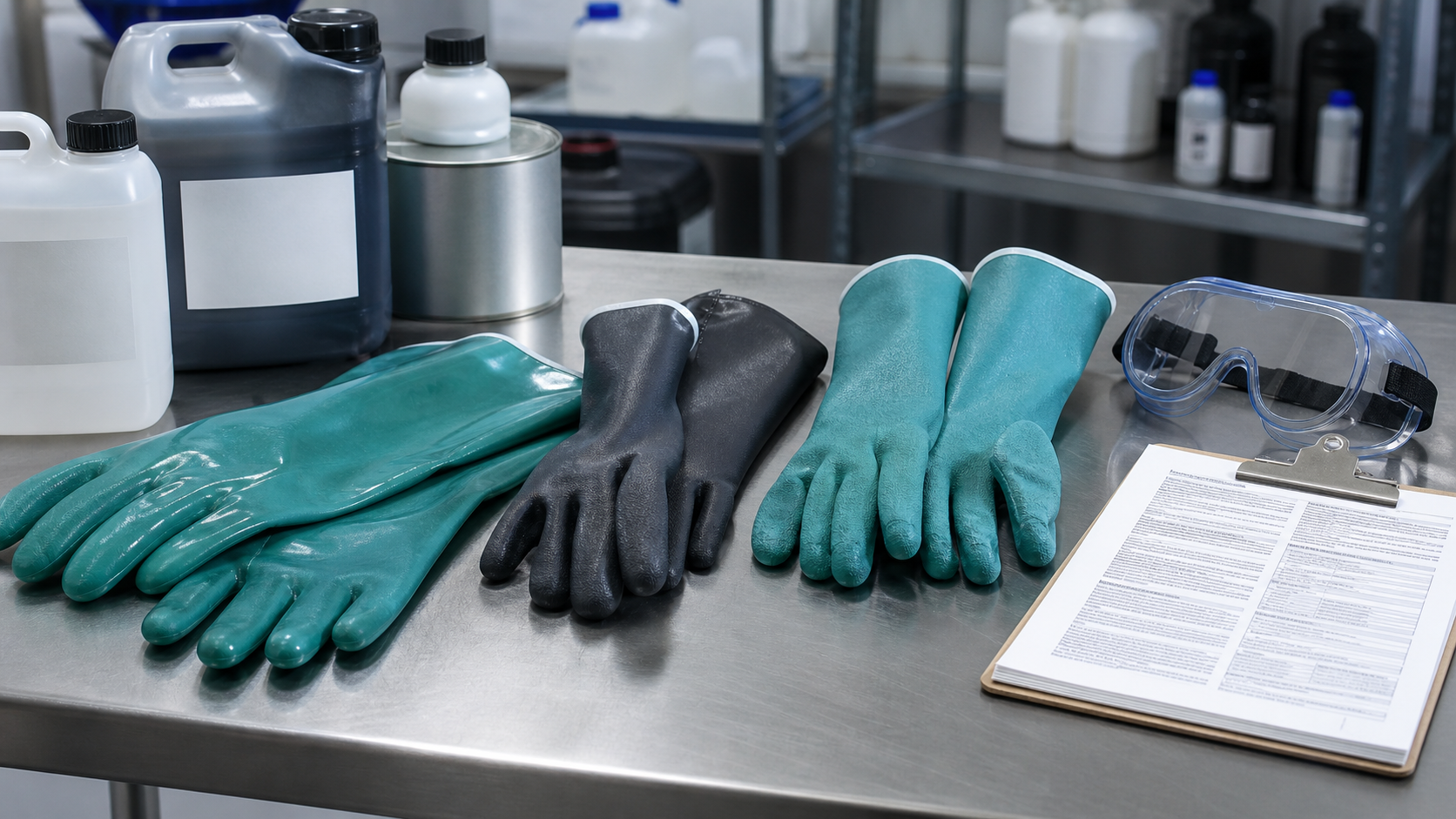
Quick Answer
Chemical-resistant gloves should be chosen by matching the glove material to the actual chemical, concentration, contact type, contact time, temperature, and task. There is no single glove material that protects against every chemical hazard, so the best starting point is the Safety Data Sheet, the glove manufacturer chemical-resistance chart, and your workplace hazard assessment.
For many worksites, nitrile, neoprene, latex, PVC, butyl, and laminated film gloves may all appear in the same glove program, but for different reasons. The right choice depends less on the glove name and more on whether the material resists permeation, degradation, and breakthrough long enough for the job.
Why Chemical Glove Selection Matters
OSHA’s hand protection rule requires employers to select hand protection when workers’ hands are exposed to hazards such as skin absorption, chemical burns, cuts, abrasions, punctures, and harmful temperatures. OSHA also says selection must be based on the glove’s performance characteristics relative to the task, conditions, duration of use, and hazards involved.
That is why “chemical-resistant” should never be treated as a generic product label. A glove that performs well against one solvent may be a poor choice for another. A glove that works for a quick splash task may not be right for immersion, extended cleaning, degreasing, pesticide handling, lab work, or industrial maintenance.
Start With The SDS
The Safety Data Sheet is the first document to check because OSHA’s Hazard Communication Standard requires SDSs to provide hazard and protective information for workplace chemicals. Look at the recommended personal protective equipment, chemical ingredients, concentration, physical form, and first-aid hazards. Then compare that information against glove manufacturer data for the exact glove model you plan to buy.
Common Chemical Glove Materials
| Glove material | Often considered for | Important caution |
|---|---|---|
| Nitrile | Oils, fuels, greases, some solvents, general chemical splash tasks | Performance varies by thickness and chemical; check breakthrough data. |
| Neoprene | Acids, caustics, alcohols, oils, and some solvents | Not universal; compare against the specific chemical and contact time. |
| Latex | Some water-based tasks, light chemical splash, dexterity-sensitive work | Latex allergy risk and limited compatibility for many chemicals. |
| PVC | Acids, bases, oils, grease, maintenance, janitorial, and wet handling | Can be bulky and may not suit aggressive organic solvents. |
| Butyl | Certain gases, ketones, esters, and highly specialized chemical tasks | Often more expensive and less dexterous; use for the right hazard. |
| Laminated film | Broad chemical resistance where splash protection is the priority | Usually limited grip, fit, and durability for hands-on work. |
How To Choose Chemical-Resistant Gloves
- Identify the chemical. Use the SDS and container label. Do not rely on a nickname such as “cleaner” or “solvent.”
- Confirm concentration. Diluted and concentrated chemicals can require different protection.
- Define the contact type. Splash, spray, wiping, immersion, and saturated rag handling are different exposures.
- Estimate contact time. Choose gloves with breakthrough protection that exceeds expected use time, then set a replacement schedule.
- Check degradation. Swelling, tackiness, stiffness, cracking, or color change can mean the glove material is failing.
- Match the glove to the job. Grip, cuff length, thickness, liner, dexterity, and abrasion resistance all matter.
- Train workers. Gloves only work when employees know when to change them and how to remove them without contaminating skin.
Quick Buying Checklist
- Chemical name and concentration are known.
- SDS PPE section has been reviewed.
- Manufacturer compatibility chart confirms the material.
- Breakthrough time is longer than the expected task duration.
- Cuff length protects the forearm when splash or immersion is possible.
- Glove thickness and grip still allow safe handling.
- Workers have a clear glove change-out and disposal procedure.
Common Mistakes To Avoid
The biggest mistake is assuming a thick glove is automatically safer. Thickness can improve durability, but material compatibility still decides whether the glove resists the chemical. Another common mistake is reusing disposable chemical splash gloves after contamination. If a glove is intended for one-time use, replace it after chemical contact or when the task ends.
Also avoid buying only one glove for the whole facility. Maintenance teams, sanitation crews, painters, lab workers, and warehouse employees may need different gloves because their hazards and contact times are different.
FAQ
What are the best gloves for chemical handling?
The best gloves are the ones tested for the specific chemical, concentration, and contact time in your task. Nitrile and neoprene are common choices, but the correct answer depends on the SDS and manufacturer compatibility chart.
Are nitrile gloves chemical-resistant?
Nitrile gloves can resist many oils, greases, fuels, and some chemicals, but not all chemicals. Thin disposable nitrile gloves and heavy nitrile gauntlet gloves also perform differently.
When should chemical gloves be replaced?
Replace them when they are contaminated beyond the planned contact time, torn, swollen, stiff, sticky, punctured, visibly degraded, or after one-time disposable use.
Mick Chan Bio
Mick Chan contributes practical safety supply guidance for eSafetySupplies.com, helping buyers compare PPE by hazard, task, compliance context, and day-to-day usability. His content is written to support safer purchasing decisions and should be paired with site-specific safety review.
Final CTA
Need chemical-resistant gloves for maintenance, sanitation, lab, or industrial work? Browse chemical-resistant gloves and related PPE at eSafetySupplies.com, and match your selection to your SDS and workplace hazard assessment before ordering.
Sources: OSHA 29 CFR 1910.138, OSHA Hazard Communication, OSHA Dermal Exposure Control and Prevention.